

A proposal from the California Stewardship Fund
The Affordable Housing
and Opportunity Act
Bring the money home. Build homes we can afford.
For more than thirty years, the State has taken a share of every community's property tax, today about $14 billion a year. The Act returns that money to the regions that generated it, to build the homes each neighborhood is missing, with every school district kept whole.
Draft for discussion · Revision 2 · September 2026
Status
What this is
One design we believe passes the four tests: a regional planning and funding concept for California housing, published in draft.
What has been checked
The arithmetic, from public sources: the property-tax shift, the school-funding flows, and the housing pipeline the scoreboard documents.
What we want to verify
Independent economic validation. Legislative Analyst review. Legal review of the fair-housing and Proposition 98 questions. No elected official or organization has endorsed it.
What we are asking
Find where it fails. Better still, bring a design that passes the tests better than this one does.
Three facts first
No new tax.
The $14 billion is property tax Californians already pay. The design reroutes it; it does not raise it.
No new institutions.
Mayors and council members already sit on each region's planning board. The design hands that board the plan and the bank; it adds no new layer of government.
It can be tested on paper.
One region can plan this without anyone's permission: where the missing homes go, what a bank would lend, and what it costs.
The idea
Bring people to opportunity and opportunity to the people
We did not write the Act because we are certain it is the answer. We wrote it to show that the space of answers is not empty: when everyone's problem is on the table at once, designs appear that nobody fighting over a single project could see. The machine below is one such design.
Its organizing idea is the line above. In high-resource communities, add affordable family homes, so people can move to opportunity. In low-resource communities, pay for the schools, parks, streets and starter homes that bring opportunity to where people already live. The research behind the two directions, the Opportunity Insights work of Chetty and colleagues, finds that both change children's outcomes. A count of housing units can push only one way; a design has to do both.
The design asks no one to act against their own interest, and it only works if everyone in it stays exactly as self-interested as they are today. The city keeps every property-tax dollar. The builder gets a yes in 60 days. The trades get approvals that become jobs. The State gets out of the enforcement business. What follows is the machine in four parts, in the order the money moves.
The machine · one of four
The money comes home
Today, for every affordable home the system delivers, it permits five to ten market-rate ones, most of them one-bedrooms. The subsidy comes as grants that average ten million dollars a project and are gone the day the ribbon is cut. None of the State's own money is in it, because the State has taken roughly a fifth of all local property tax since 1992 to pay its school bill.
$14 billion
a year, about 5% of the state budget
The design returns that property tax to the regions that generated it, because the money the housing system lacks is already in the system: it is paying the State's school bill. The State pays that bill from its own revenues instead, every district held whole under Proposition 98, with new schools built where the homes go.
The return also reverses a thirty-year incentive. Since 1992, a city has had little to gain from new homes and plenty to lose. When the tax stays home, the homes a city plans for grow its own roll.
The machine · two of four
A region plans in both directions
Mayors and council members already sit on each region's planning board; under the Act, that board writes the regional housing plan. The reason it is the region, and not the city or the State, is what each can see. A city sees only its borders. The State sees only numbers. The region sees where homes, jobs and schools connect, and it can read a map like this one.
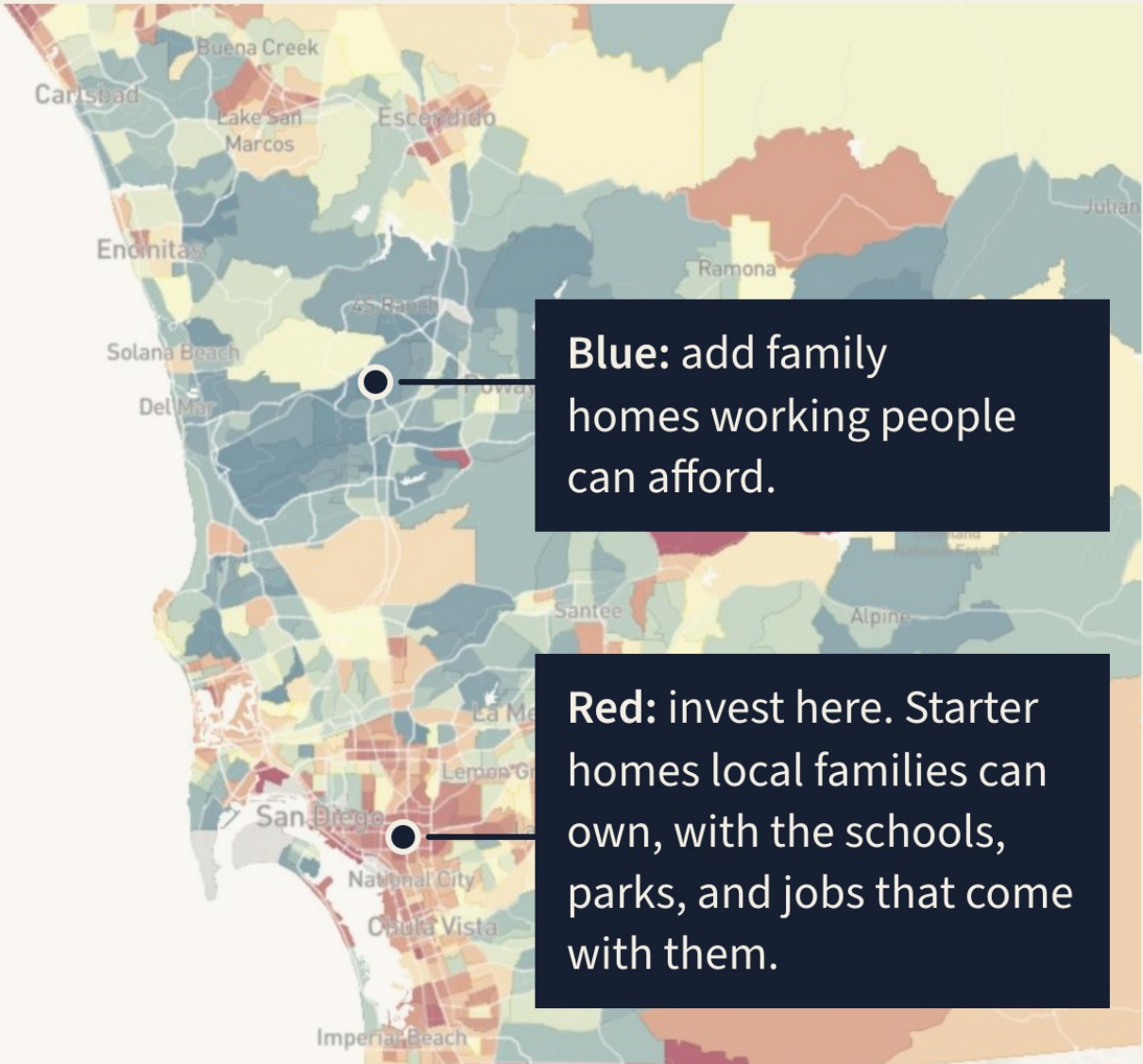
San Diego County, colored by what children from low-income families grow up to earn. The design reads the map in both directions: add affordable family homes where opportunity is high, and invest where it is missing.
Map: Opportunity Atlas, Opportunity Insights and U.S. Census Bureau; © Mapbox, © OpenStreetMap.
Bring people to opportunity
In high-resource communities, the design builds affordable family homes, two bedrooms and up, dispersed through mixed projects built to the same standard as everything around them, without the towers.
Bring opportunity to people
In lower-income communities, it pays for infrastructure as grants, not loans: schools, parks, streets. It builds market-rate starter homes on land families can afford, with connection investment first for isolated neighborhoods.
The region sets each city's share, and each city shapes its own piece in its own general plan: the sites, the densities, the standards. Every city delivers, and every city has a say.
Today, housing is a tug of war between the State and the city. The State pulls for the project, the city pulls against it, and residents pay the price whichever side wins.
The machine · three of four
Rules everyone can count on
Today a city cannot know what will be built on any site: density bonus law adds up to 50% and waives standards, the builder's remedy ignores zoning, and streamlining statutes entitle projects the plan never contemplated. So evacuation, fire flow, water and school capacity get sized against a plan that will not be the outcome, and residents lose whether a project is built or stopped. The uncertainty costs builders too: approvals outrun construction by hundreds of thousands of homes, 874,000 built against 1.1 million approved, because discretionary review, litigation and years of entitlement risk price out everyone but the largest projects.
The design makes the adopted plan govern, because a plan that governs is the only form of voice that survives contact with a project. Health, safety and environmental review happen once, at the plan level, with the height, view and shade rules residents help write, and anything that conforms is approved. No density bonus, no builder's remedy, no State override of an adopted plan.
Delivery is measured by formula rather than argued case by case: a city that delivers its share keeps every dollar, and one that does not has its own property tax used to build the share, to its own standards. The point of the formula is a plan a city can size its infrastructure against.
The State funds the system, sets the need method and the civil-rights, fair-housing and safety floor, and reviews regions on outcomes. The region plans and lends. The city shapes and builds. No one overrides anyone, because each has a job the other two need done.
Reviewed once.
Safety and environmental review happen up front, on the whole plan, so no project-level litigation re-fights what the plan already settled.
Approved in 60 days.
A project that fits the plan gets its yes in 60 days, without a new fight over every building.
No surprises.
Only what is planned gets built. A builder knows what a site allows before buying it, which leaves nothing to negotiate and nothing to litigate.
The machine · four of four
The bank
The property tax that comes home is not spent; it is lent. The returned tax capitalizes a regional housing bank, and the bank does three things.
It lends.
Low-cost construction and permanent debt to those who build the homes in the plan, and mortgages and down-payment seconds, at the bank's cost of funds, to those who buy them.
It pays.
For the schools, parks and streets those homes need, as grants rather than loans, in the communities that cannot fund them from their own tax base.
It holds.
The land under the covenanted homes, in perpetuity, leasing it back so a home priced for a teacher this year is priced for a teacher at every resale.
The loop is the design's engine. Alongside it, the bank pays infrastructure grants and holds the land under the covenanted homes.
It lends at cost because the spread is the subsidy, and a lending subsidy recycles where a grant does not: a loan repaid funds the next home. It builds family-sized covenanted homes at 80 to 120% of median income, rentals and homes to own, with shared-appreciation seconds that recycle the same way. For the incomes the bank cannot reach on its own, the design adds an Opportunity Fund, a property-tax exemption for covenanted bedrooms, land at nominal ground rent and loans without fees, so that operators serving the deepest incomes stop stacking ten funding sources to close one project.
What a dollar does
A grant dollar builds once. When the project is built, the dollar is gone.
A bank dollar builds, comes back, and builds again. Construction loans at cost turn over every two to three years, so one dollar funds three to five homes' construction in a decade. A dollar a year of returned property tax supports roughly $13 to 15 of up-front capital when bonded over thirty years. The homes it builds then add to the property-tax roll, which now stays in the region.
Figures in this panel are order-of-magnitude and drawn from public sources; independent economic validation has not been done.
The scorecard
Scored against the four tests
The four tests say what any housing law has to deliver; the machine above is our attempt to deliver it. We designed the Act to pass all four. Whether it does is what review is for.
Homes we can afford.
Family-sized covenanted homes at 80 to 120% of median income, rentals and homes to own, kept affordable at every resale by the land the bank holds.
Opportunity where you live.
Family homes where opportunity is high, and infrastructure and starter homes where it is missing, with the bank closing the gap where homes cost more to build than the market there can pay.
Homes that get built.
Locked standards, a 60-day approval for anything that conforms to the plan, and debt at cost that makes the planned homes the profitable ones to build.
A voice.
Cities and residents shape the plans, and the adopted plan governs: no density bonus, no builder's remedy, no State override.
The standards and the measures live on the four tests, where this design, and any other, can be held to them.
What happens next
The first step is a paper plan
The first test of this design is not a campaign. We are asking a working group of San Diego County electeds, convening this fall, to plan their own region on paper: where the missing homes go, what a regional bank would lend, and what it costs. A paper plan is cheap and it is specific. If the design fails, the paper will show it, and finding that out will have cost nothing. If it holds, the region that drew it will know exactly what it is asking the Legislature for.
The sequence from there, the data bill, the reviews and the choice of vehicle, is on How this gets decided.
Tell us where it fails
Every mechanism on this page is open to argument: the need method, the school funding, the bank's math, the politics. Objections from the people whose work it touches are how the next revision gets written, and each revision is dated at the top of this page.
Follow the revisions
One email when the Act moves: a new revision, a study back, a bill in print.