California Stewardship Alliance californiastewardship.org

The record

Who decides what gets built?

This is not an argument about whether California should build housing. It is an account of who holds the authority to approve it, and how that authority moved.

A sourced account of how California housing approvals moved from local discretion to state law, 2014–2026. About fifteen minutes to read. Every date, figure and vote below links to its source.

The claim

What changed.

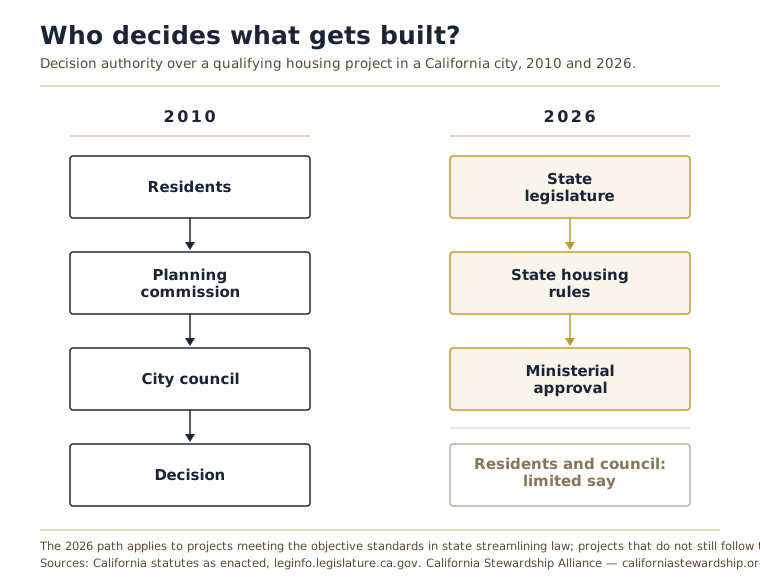
Decision authority in 2010 A single downward chain: residents, then the planning commission, then the city council, then the decision. 2010 Residents Planningcommission City council Decision Decision authority in 2026 A single downward chain: the state legislature, then state housing rules, then ministerial approval. Separately noted below the chain: residents and council have limited say. 2026 Statelegislature State housingrules Ministerialapproval Residents and council: limited say

Decision authority over a qualifying housing project, 2010 and 2026. The 2026 path applies to projects that meet the objective standards written into state streamlining law; projects that do not still follow the 2010 path. Download this diagram (SVG) →

In 2010, a qualifying housing project in a California city ran through residents at a public hearing, a planning commission, and an elected council. Each of those bodies could weigh it, condition it, or turn it down.

In 2026, a qualifying project can run through state law to ministerial approval, with little or no local discretion at any of those three stages. That change was deliberate. It was legislated in public, over roughly a decade, by named authors in recorded votes.

Method

The account below is built from bill text, recorded votes, and the City of Menlo Park’s project file. Where those conflict with each other or with published summaries, both readings appear. Where a figure comes from journalism rather than a filing, the entry says so.

The sources are grouped by chapter and labelled by type. A government record and an advocacy report are not equivalent evidence, and the labels let you weigh them separately.

The chronology

1982 to 2026, at a glance.

Every row links to the chapter that documents it.

2013 – 2016

Chapter one: a real crisis creates a movement

Through the mid-2010s the Bay Area added jobs faster than it added homes. Rents and prices climbed accordingly. The frustration that produced was real, and the people who organized around it were not wrong about the shortage.

In early 2014, Sonja Trauss founded the San Francisco Bay Area Renters’ Federation — SF BARF — and began appearing at planning meetings to speak in favor of projects that neighbors had turned out to oppose. At the start it was a volunteer operation.

It did not stay one for long. Tech backing arrived almost immediately: Yelp chief executive Jeremy Stoppelman gave Trauss financial support in SF BARF’s first year, and by 2015 she had raised enough to advocate full-time.

The sequence is not grassroots first and money later: an early volunteer movement attracted tech backing almost immediately, then institutional funding at scale two years after that.

2017 – 2019

Chapter two: money arrives at scale

California YIMBY was founded in the summer of 2017 as a statewide advocacy organization. The money that arrived with it was of a different order than anything SF BARF had raised, and it came in three separately reported tranches: $500,000 from Dustin Moskovitz and Cari Tuna through Open Philanthropy; a separate $500,000 raised by Nat Friedman and Zack Rosen; and $1 million from Stripe.

Open Philanthropy renamed itself Coefficient Giving in November 2025. It describes itself as the largest national funder of the YIMBY movement since 2015, and its own announcement credits its grantmaking with helping launch that movement. That is the funder’s account of its own role.

Where these figures come from

California YIMBY is a 501(c)(4). It is not required to disclose its donors and does not. The three figures above therefore come from journalism and from the funders’ own statements rather than from filings, and the outlets that did the original reporting are largely the movement’s critics.

The filed record is narrower. California YIMBY’s political action committee reports to the Secretary of State, and those reports are exact, but a PAC is a slice of the money rather than the whole of it. We are a 501(c)(4) under the same disclosure rules.

Money, advocacy, and legislation

These are three separate records, and this account keeps them separate. Contributions are documented where they are documented; bills and votes are documented separately. Nothing here asserts that a contribution produced a vote or an outcome. Where the two appear in sequence, only the sequence is being reported.

2017 – 2020

Chapter three: after the money came the laws

SB 35 (Wiener) was signed September 29, 2017: ministerial approval for qualifying multifamily projects in cities behind on the housing targets the state assigns them. It was narrow by design — conditional on those targets, carrying affordability set-asides, and written to expire on January 1, 2026. Signed

The same session put enforcement behind a much older law. The Housing Accountability Act, enacted in 1982, bars a city from denying a housing project that complies with the city’s own objective standards except on narrow health-and-safety findings — and for thirty-five years it carried little penalty and saw little use. SB 167 and its companion AB 678 raised the evidence a city must produce to deny a compliant project, mandated attorney’s fees for successful challengers, and directed courts to fine cities that violate it; AB 1515 widened the projects the Act protects. It is one of the two laws the Attorney General would later cite against Menlo Park. Signed

The broad version followed, and failed. SB 827 (Wiener, 2018), sponsored by California YIMBY, would have overridden local zoning near transit statewide. It died in the Senate Transportation and Housing Committee on April 17, 2018. Failed

Accounts differ on the exact committee tally. All of them agree that four of the thirteen members voted yes; the disagreement is over how the no votes and abstentions were recorded. Both versions are in the sources.

The following year, another bill passed. SB 330 (Skinner), the Housing Crisis Act, was signed October 9, 2019. It reaches process rather than zoning: a compliant housing project can face no more than five public hearings, and the standards it is judged against lock at the moment a preliminary application is filed rather than the moment a city decides. SB 8 later extended it through January 1, 2030. Signed

SB 50, the second attempt and also sponsored by California YIMBY, failed on the Senate floor 18–15 on January 29, 2020, and again on January 30 — three votes short of the 21 needed for passage. Failed

Nothing here went to voters. No Californian cast a ballot on any of these bills. In the same four years, the Legislature rejected the two broad zoning overrides and enacted the quieter three: a conditional ministerial path, teeth for a dormant enforcement act, and a cap on local process. The broad idea did not go away; it changed form.

2021 – 2023

Chapter four: one bill becomes many

One bill becomes many SB 35, signed in 2017, and two failed statewide bills, SB 827 in 2018 and SB 50 in 2020, converge on a single branch point. From it, six enacted bills follow: SB 9, AB 2011, SB 423 — the SB 35 extension — SB 4, SB 684, and Density Bonus expansions. SB 35 (2017) SIGNED SB 827 (2018) FAILED SB 50 (2020) FAILED SB 9 SIGNED AB 2011 SIGNED SB 423 SIGNED SB 4 SIGNED SB 684 SIGNED Density Bonusexpansions SIGNED

The prototype passed; the broad versions failed; the bills that followed broadened the prototype — SB 423 extends SB 35 directly. Connectors mark sequence, not causation.

Between 2021 and 2023, the Legislature enacted a set of narrower bills, most of them broadening the ministerial mechanism SB 35 had prototyped in 2017. Together they carried much of what SB 827 and SB 50 had attempted at once.

SB 9 (Atkins) was signed September 16, 2021 and took effect January 1, 2022: ministerial approval for duplexes and lot splits in single-family zones statewide. Signed

AB 2011 (Wicks) was signed September 28, 2022. Qualifying projects on commercially zoned land are ministerial and exempt from environmental review under CEQA. Signed

SB 423 (Wiener) was signed October 11, 2023. It extends the SB 35 streamlining process to January 1, 2036. Signed

SB 423 also applies that streamlining inside portions of the Coastal Zone that SB 35 had excluded. For a coastal city, this is the operative provision.

The SB 423 coalition

SB 423’s co-sponsors were California YIMBY, the California Housing Consortium, the California Conference of Carpenters, the Local Initiatives Support Corporation, and the Inner City Law Center — a construction trades union and two affordable-housing legal organizations alongside the tech-funded advocacy group.

The coalition behind these laws is broader than their best-known funder. A description of the decade as tech money against cities does not survive the sponsor list.

What “ministerial” means

A discretionary approval is one your city can weigh, condition, or deny. A ministerial approval is one it must grant if the application meets the standards written into state law. If a project checks the boxes, your elected officials may have little or no discretion to say no.

2024 – 2026

Chapter five: after the laws, the crisis got worse

California ran a decade-long experiment in who decides. What did Californians receive in return?

The most useful assessment of these laws came from a group that supported them. In February 2025, YIMBY Law — a pro-housing organization that litigates under these statutes and the Housing Accountability Act, and a proponent of the laws it was reviewing — published a report on the laws passed since 2021. Its conclusion was that they have had “limited to no impact on the state’s housing supply.”

What the report found, and what the permit data shows

SB 9
Permits for 140 units statewide in 2023. Los Angeles received 211 applications in year one; San Diego received seven.
AB 2011
Two project approvals in 2023. Eight in 2024.
SB 6 and SB 4
The report found no projects using them.
Local response
YIMBY Law counted 140 local ordinances in the two years after SB 9 designed to blunt it.
Permits statewide
About 102,000 in 2024, roughly 10,000 fewer than 2023. In the first half of 2025, 49,400 — the lowest since 2014 outside the pandemic shutdown, and 16% below the prior 37-year average.

What the laws were passed to fix

Affordability
At the post-crash peak in early 2012, 56% of California households could afford the median-priced home. By the fourth quarter of 2025, 18% could; the median stood at $869,300.
Homelessness
134,278 Californians were homeless on a single January night in 2017, the year the first streamlining law passed. In January 2024 the count was 187,084 — 28% of the national total, two-thirds of them unsheltered.
Who the new homes serve
Of the homes completed statewide from 2021 through 2025, five were priced at moderate income or above for every one affordable to a lower-income household.

The case against this reading

Economists attribute much of the 2024–25 permit decline to interest rates and construction costs rather than to housing law. Several of these statutes are also new enough that a fair verdict on them is not yet available. Both objections hold.

The same caution applies to the conditions above. Affordability worsened in every high-cost state as interest rates rose, and the 2012 comparison point is a post-crash peak. Homelessness rose nationally over the same years — and in the most recent count, California’s one-year increase of 3% was far below the national 18%, while the state posted the nation’s largest one-year reductions in veteran and youth homelessness. These trends do not convict the statutes.

None of this disturbs the account above, which does not depend on these laws having caused any of it. What is documented is narrower: authority moved from local governments to state law, and the conditions the transfer was sold as fixing — supply, cost, homelessness — did not improve while the transfer completed. Whether the second follows from the first is an open question here.

2021 – 2026

Chapter six: capital follows opportunity

Judged by what got built, the experiment failed. Judged as a change in the rules of investment, it succeeded completely. Stack the pieces the decade put in place — ministerial approval, which replaces hearings with a checklist; density bonuses, which let a compliant project rise far past the zoning underneath it; and mandatory fines for cities that say no anyway — and a developer can propose 665 units in towers up to 458 feet, with a hotel, at the edge of a largely single-family neighborhood, by checking the boxes. That is not a hypothetical. It is the live case below.

Projects of that shape are what institutional capital exists to own: hundreds of rental units under one sponsor, income spread across hundreds of leases, a hold measured in decades. The one variable no underwriter could price — the discretionary hearing — is the variable the statutes removed, from precisely the asset class the largest pools of capital most wanted. Capital noticed, as capital does.

The capital shift, measured

Portfolio rotation
Institutional portfolios spent the decade rotating out of offices and into residential rental, which has overtaken office as the largest sector of the benchmark institutional property index.
The federal backstop
Fannie Mae and Freddie Mac stand behind apartment lending the way they stand behind home mortgages — no other commercial property type has that. Their multifamily business grew from $33 billion at the end of 2010 to a $140 billion combined cap for 2021.
Ownership consolidation
Individual investors held 47.8% of the nation’s rental units in 2015 and 37.6% five years later. In buildings of 150 units or more, partnerships and LLCs hold roughly two-thirds of the units; individuals, one in twenty.

The rules also select who can use them. Objective-standards review, affordability set-asides, and the labor standards attached to AB 2011 and SB 423 carry compliance costs that spread thin across four hundred units and crush four — the Terner Center at UC Berkeley puts the prevailing-wage premium alone at roughly $94,000 per unit. Nothing in the statutes names a preferred builder; at project scale they select one anyway.

The rental tilt is written into the subsidy system. The largest affordable-housing subsidy in the country, the federal Low-Income Housing Tax Credit, can finance rental homes only, and California’s deed-restriction machinery runs on it. The output matches the machinery. Of the affordable homes completed statewide from 2021 through 2025, roughly nineteen in twenty were rentals. Count every home completed in that window, at any price, and fewer than one in 380 was a deed-restricted home a family could buy. California’s homeownership rate, 55.3% in 2025, stands roughly ten points below the nation’s — and the entitlement pipeline, measured the same way, contains almost nothing built to move it.

What this does not claim

Rental housing houses people, and a rental-heavy pipeline is not by itself a failure. The institutional turn toward built-to-rent housing is national — strongest, in fact, in Sun Belt metros with none of California’s streamlining laws — and interest rates and land costs drive it at least as hard as statute does. Nothing in the record shows development capital writing these bills; the sponsors on file are the ones named in chapters two and four.

What is documented is narrower. The statutes award their certainty to the projects institutional capital prefers to underwrite. The subsidy system pays only for rental. And the housing that comes out the other end is rental housing at institutional scale.

The live case

80 Willow Road, Menlo Park.

This is what that authority looks like as a docket.

80 Willow Road is the former Sunset Magazine headquarters — 6.7 acres in the Linfield Oaks neighborhood, determined eligible for the National Register of Historic Places and listed in the California Register of Historical Resources.

The proposal, from N17 Development representing Willow Park LLC, is approximately 665 residential units, 332,000 square feet of office, 17,000 square feet of retail, and 164,000 square feet of hotel with 130 rooms. Three of the buildings would range from 301 to 458 feet tall. A fourth, a preschool, would be 22 feet.

Menlo Park has found the application inconsistent with its own development standards five times, and has repeatedly determined that it does not qualify for AB 2011 streamlining — most recently on May 6, 2026.

On July 29, 2026, the Attorney General’s office sent the city written notice under AB 712 stating that Menlo Park had violated AB 2011 and the Housing Accountability Act — the 1982 law whose enforcement history chapter three traces.

AB 712, signed October 10, 2025, keys its penalties to the Housing Accountability Act’s fine schedule and extends them across the state’s housing reform laws: a court must fine a local agency that loses one of these suits, and a prevailing applicant is entitled to attorney’s fees. Where the Attorney General has given the agency written notice first, the minimum fine is higher. It starts at $10,000 per unit.

On August 3, 2026, the developer’s attorney gave notice of intent to sue. The council met in closed session on August 5.

A city applying its own development standards has been told by the state that doing so is itself a violation.

The proposal is for approximately 665 units. The statutory minimum fine, after a written warning, starts at $10,000 per unit.

Every fact in this section comes from the City of Menlo Park’s project file.

What we are for

What got thrown out along the way.

California’s streamlining laws were written to remove discretionary delay, and they did. But qualifying projects are also exempt from environmental review, and the objective standards they are measured against say little about fire flow, evacuation capacity, or whether the ground under a project can support it. The review did not get faster. At the entitlement stage — the stage where a community can still say no — much of it stopped happening.

We think California can build the housing it needs without discarding the part of the process that asks whether a project is safe where it stands. That is the work: documenting where streamlined approvals skip the questions that matter, and giving cities and citizens the tools to ask them anyway.

This page is an example of that work. If it was worth your time, it was funded by people who wanted it to exist.

The Scoreboard →

The numbers behind this account — every figure, with the arithmetic shown.

Our strategy →

What we are building, at the municipal, legislative and constitutional level.

Campaigns →

The live cases, with the public record behind each claim.

City officials and reporters who want to go through any of this directly: write to us.

Occasional updates as this record develops

Infrequent. Unsubscribe any time.

Sources

What each claim rests on.

Each entry gives what it supports, the publisher, and the source type. Where accounts conflict, both are listed. If you find an error, tell us and we will correct it with a date stamp.

Chapter 1 — A real crisis creates a movement

  1. Sonja Trauss founded SF BARF in 2014 and began organizing testimony in favor of projects.

    San Francisco Examiner Journalism

  2. Jeremy Stoppelman gave Trauss financial support in SF BARF's first year; by 2015 she was advocating full-time.

    In These Times Journalism

    In These Times is editorially opposed to the YIMBY movement. The San Francisco Standard, below, is not, and reports the same early-funding sequence.

  3. The founding sequence and early funding of the Bay Area YIMBY groups.

    The San Francisco Standard Journalism

Chapter 2 — Money arrives at scale

  1. California YIMBY founded summer 2017; the three funding tranches — $500,000 via Open Philanthropy, a separate $500,000 raised by Nat Friedman and Zack Rosen, and $1 million from Stripe.

    Dollars & Sense Journalism

    Dollars & Sense is a left-leaning magazine critical of the YIMBY movement. The three tranches are reported figures rather than filed ones, and this is the weakest sourcing on the page. See the note in Chapter 2.

  2. Grants to California YIMBY, in the funder's own database.

    Open Philanthropy (now Coefficient Giving) Funder

    The record linked is the 2019 general-support grant, not the 2017 tranche cited above.

  3. Open Philanthropy renamed itself Coefficient Giving in November 2025, describes itself as the largest national funder of the YIMBY movement since 2015, and credits its grantmaking with helping launch the movement.

    Coefficient Giving Funder

    The funder's description of its own role, rather than a critic's summary of it.

  4. California YIMBY's political action committee filings — the public, filed record.

    California Secretary of State (Cal-Access) Government record

    The harder source, and a narrower slice of the money than the c4 figures above.

  5. Background and chronology of California YIMBY.

    Wikipedia Tertiary

    Listed as a navigational aid to the underlying citations, not as evidence.

Chapter 3 — After the money came the laws

  1. SB 35 (Wiener) — signed September 29, 2017; ministerial approval for qualifying projects in jurisdictions behind on their state housing targets, with affordability set-asides and an original sunset of January 1, 2026.

    California Legislative Information Government record

  2. The Housing Accountability Act, Government Code §65589.5, enacted 1982 — the current text, including the fine schedule AB 712 builds on.

    California Legislative Information Government record

  3. SB 167 and its companion AB 678 (2017) raised the evidentiary standard for denying a compliant project, mandated fee awards, and directed courts to fine violating cities; AB 1515 (2017) broadened the Act's protections.

    California Legislative Information Government record

    Three separate bills amending the same Act, signed alongside SB 35 in the September 2017 housing package. The claim that the Act was lightly enforced before 2017 rests on the amending bills' own legislative findings.

  4. SB 827 (Wiener, 2018) — bill text and legislative history.

    California Legislative Information Government record

  5. SB 827 died in the Senate Transportation and Housing Committee on April 17, 2018.

    California Legislative Information Government record

    Accounts of the committee tally differ — 4–6 and 4–7 are both reported, with abstentions counted differently against a thirteen-member committee. All agree that four members voted yes, which is the figure used above.

  6. SB 330 (Skinner), the Housing Crisis Act — signed October 9, 2019; caps hearings on a compliant project at five and vests development standards at preliminary application. SB 8 (2021) extended it to January 1, 2030.

    California Legislative Information Government record

  7. SB 50 (Wiener) — bill text and legislative history.

    California Legislative Information Government record

  8. SB 50 failed on the Senate floor 18–15 on January 29, 2020 and again on January 30, three votes short of the 21 required.

    California Legislative Information Government record

Chapter 4 — One bill becomes many

  1. SB 9 (Atkins) — signed September 16, 2021, effective January 1, 2022.

    California Legislative Information Government record

  2. AB 2011 (Wicks) — signed September 28, 2022; ministerial and CEQA-exempt for qualifying projects.

    California Legislative Information Government record

  3. SB 423 (Wiener) — signed October 11, 2023; extends SB 35 streamlining to January 1, 2036 and into portions of the Coastal Zone. The bill record also carries the co-sponsor list.

    California Legislative Information Government record

  4. SB 6 and SB 4 — bill text.

    California Legislative Information Government record

  5. SB 684 — bill text.

    California Legislative Information Government record

Chapter 5 — After the laws, the crisis got worse

  1. The February 2025 finding that laws passed since 2021 have had “limited to no impact on the state's housing supply”; the SB 9, AB 2011, SB 6 and SB 4 counts; and the count of 140 local ordinances designed to blunt SB 9.

    YIMBY Law Advocacy organization

    YIMBY Law is a pro-housing legal advocacy organization and a proponent of the statutes it assessed — a source reporting against its own interest. The link is YIMBY Law's February 24, 2025 announcement of the report; the report PDF itself is hosted off-site and linked from that page, so the permalink above is the stable citation.

  2. Coverage of the YIMBY Law report and its figures.

    CalMatters Journalism

    Corroborating coverage, not the primary source.

  3. Statewide permit counts for 2023, 2024 and the first half of 2025.

    U.S. Census Bureau, Building Permits Survey Government record

  4. California's point-in-time homelessness count of 134,278 in January 2017 — 25% of the national total, with 68% unsheltered.

    U.S. Department of Housing and Urban Development, 2017 Annual Homeless Assessment Report Government record

  5. California's count of 187,084 in January 2024 — 28% of the national total, 66% unsheltered — and the counter-reading figures: the state's 3% one-year increase against 18% nationally, and the nation's largest reductions in veteran and youth homelessness.

    U.S. Department of Housing and Urban Development, 2024 Annual Homeless Assessment Report Government record

    HUD's own report cautions that point-in-time counts likely undercount. The comparison here uses the same method at both endpoints.

  6. Housing affordability: 56% of California households could afford the median-priced home at the early-2012 peak; 18% in the fourth quarter of 2025, at a median of $869,300.

    California Association of Realtors, Housing Affordability Index Trade association

    The Realtors are a party with interests of their own; the index is used here because it is the standard series and runs unbroken across the period. The 2012 endpoint is a post-crash affordability peak — prices were depressed and rates low — which is why the counter-reading panel says so.

  7. Of homes completed statewide 2021–2025, five were priced at moderate income or above for every one affordable to a lower-income household.

    California Stewardship Alliance — The Scoreboard Our analysis

    Our computation from the state's Annual Progress Report data, with the snapshot and scripts downloadable from that page. The exact built-stage ratio is 5.0 to 1.

Chapter 6 — Capital follows opportunity

  1. Ownership of rental units by entity type, 2020: individual investors held 37.6% of units; LLPs, LPs and LLCs held 40.4%, including 68.5% of units in properties of 150 units or more, where individuals held 4.9%.

    Congressional Research Service, R47332, from the HUD/Census Rental Housing Finance Survey Government record

    CRS's own caveat carries over: some LLCs are individual owners who have structured their holdings through a business form, so the LLC share is an upper bound on institutional ownership, not a measure of it.

  2. Individual investors held 74.4% of rental properties but 47.8% of rental units in 2015; between 2001 and 2015, non-individual ownership of 25–49-unit properties rose from 66.1% to roughly 81%.

    Joint Center for Housing Studies, Harvard University Academic research

    JCHS analysis of the 2015 Rental Housing Finance Survey against the 2001 Residential Finance Survey. The two surveys differ in method; the direction of the change is consistent across both comparisons.

  3. FHFA set Fannie Mae and Freddie Mac's combined multifamily purchase caps at $140 billion for 2021.

    Federal Housing Finance Agency Government record

  4. GSE multifamily volume at its post-crisis low: $33 billion at the end of 2010, before nearly doubling to over $62 billion by the end of 2012.

    Urban Institute Academic research

  5. Residential has overtaken office as the largest sector of the NCREIF institutional property index.

    CRE Daily, reporting NCREIF index data Journalism

    Industry press summarizing NCREIF's published sector weights; cited for the rotation, not for a precise figure.

  6. The federal Low-Income Housing Tax Credit finances rental housing only.

    26 U.S.C. §42, via Cornell Legal Information Institute Government record

    The statute's qualified-basis rules apply to residential rental buildings; owner-occupied units are ineligible.

  7. Prevailing-wage requirements add roughly $94,000 per unit in construction costs.

    Terner Center for Housing Innovation, UC Berkeley Academic research

    Measured on LIHTC-financed affordable projects, not on AB 2011 projects specifically. The figure is used here for the scale of the compliance cost, not as an AB 2011 estimate.

  8. Tenure composition, 2021–2025: roughly nineteen in twenty affordable completions were rentals, and fewer than 1 in 380 of all completions was a deed-restricted home a family could buy — at the entitlement stage as well as at completion.

    California Stewardship Alliance — The Scoreboard Our analysis

    Our computation from the state's Annual Progress Report data. The frozen data snapshot, analysis scripts, and a numerator audit are downloadable from that page. Labelled here by the same rule applied to every other advocacy source in this list.

  9. Build-to-rent construction is a national trend, led by Sun Belt metros — Phoenix, Dallas, Atlanta — without California-style streamlining laws.

    CRE Daily Journalism

    Industry press, cited for the direction and geography of the trend rather than for a precise figure.

  10. California homeownership rate, 55.3% in 2025, against the national rate.

    Federal Reserve Bank of St. Louis / U.S. Census Bureau Government record

The live case — 80 Willow Road, Menlo Park

  1. Every fact in this section: the site, the historic listings, the proposal's unit and square-footage figures, the building heights, the applicant, the five consistency determinations, the AB 2011 ineligibility determinations through May 6, 2026, the Attorney General's July 29, 2026 notice, and the developer's August 3, 2026 notice of intent to sue.

    City of Menlo Park — Community Development, Projects under review Government record

    Every figure in this section was checked against this page rather than against press coverage.

  2. AB 712 (Wicks) — signed October 10, 2025; court-imposed fines on local agencies that lose these suits, keyed to the Housing Accountability Act's fine schedule in §65589.5(k), attorney's fees for prevailing applicants, and the higher minimum fine where the Attorney General gave written notice first.

    California Legislative Information Government record

Bill text and vote records are linked to leginfo.legislature.ca.gov, the Legislature’s own site. 80 Willow Road facts are linked to the City of Menlo Park’s project file rather than to press coverage of it. Funding figures name the outlet inline, because the organization they describe is a 501(c)(4) and does not disclose its donors.